Google Ads Hidden Search Terms Report 2026
 George Prodanov
October 27, 2026

In September 2020, Google famously started reducing search term visibility by only showing queries searched by “a significant number of users”, citing privacy concerns. Columbia Business School professor Kinshuk Jerath told the court during the US v. Google search antitrust trial that for “20 percent of their spend on Google, the advertisers were not even told which queries they’re buying” (Tr. 5470).
A few years later, the share of hidden search terms has continued to increase as reported by a number of independent studies. We’ve decided to measure the share of hidden search terms ourselves and publish the findings. The Google Ads Hidden Search Terms Report analyses anonymised data from our PPC Consultancy Google Ads Manager Account (MCC).
The aim is simple: track the true share of hidden search terms, put a value on what they cost, and contribute to the third-party research on the matter. No recent study we could find splits the hidden share by match type and attaches performance to it, so this one does. Fundamentally, we consider the practice a form of Google tax. Advertisers pay a charge for clicks across low-quality inventory they’re unable to see, and therefore unable to opt out of.
The data covers 1 January to 24 October 2026 across the client accounts in the PPC Consultancy MCC. The data covers millions of searches and ad spend. Google reports two views of the same traffic. The keyword view shows every impression, click, pound and conversion each keyword generated. The search terms report shows only the queries Google chose to show us.
We simply subtract the keyword data from the search term data, by match type, to calculate the hidden traffic: impressions, clicks, and spend Google billed us for without showing the corresponding search term. Every hidden click is a click we paid for on a query we were never shown. Please note, while we have multiple clients across a broad range of industries and markets, ultimately this is data from one MCC. Please treat these numbers as a snapshot rather than a universal across all industries and markets.
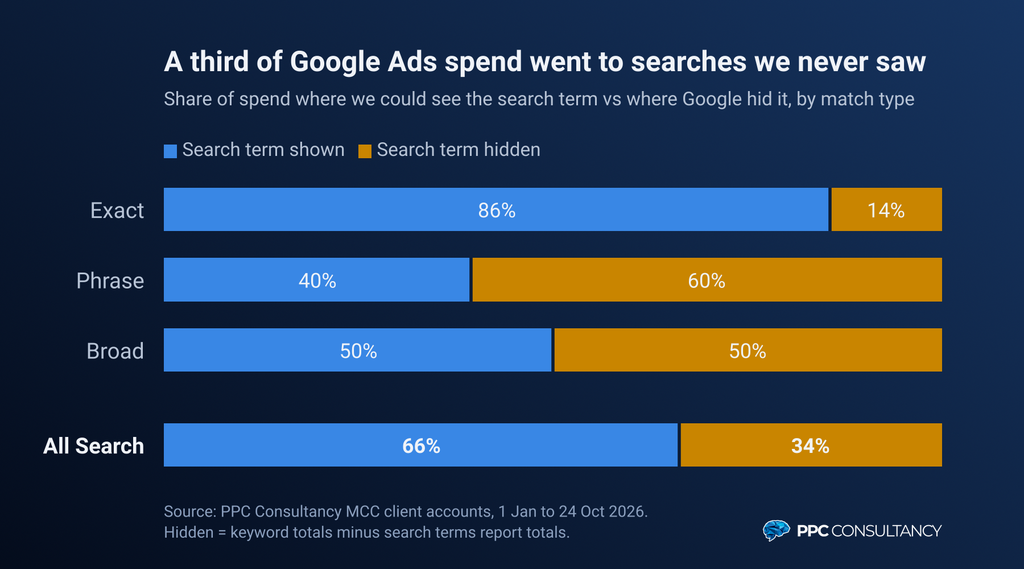
A third of media spend went to clicks with no visible search term
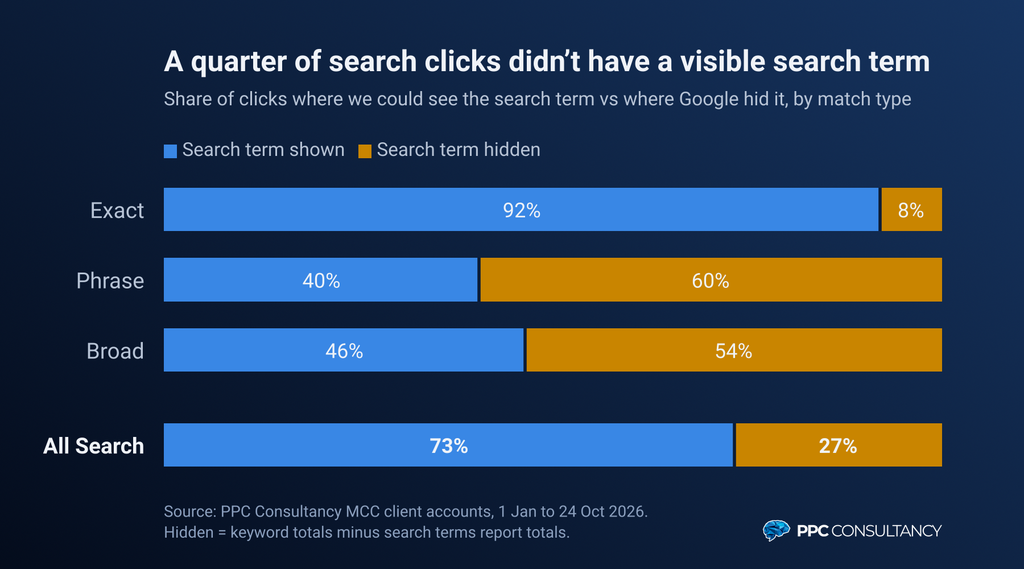
34% of our Search spend went to clicks with no visible search term, while 32% of impressions and 27% of clicks had no visible search term against them, respectively. 34% sits between Seer Interactive’s 28% in a 2020 study and Mark Meyerson’s 40% in a similar study from 2024.
The exact criteria Google uses to determine which search terms get hidden and which don’t remain unclear. Their official documentation says search terms “that don’t have enough query activity” are omitted from the report, and that its thresholds “ensure user anonymity by only reporting on terms that have seen sufficient search volume”. What counts as sufficient is undisclosed.
Google has claimed for years that 15% of the searches are unique and have never been searched before. Moreover, AI Mode, searches keep getting longer and more specific, and the pool of so-called rare queries is growing. Google’s own data puts the average AI Mode search at triple the length of a traditional query, with AI Mode use more than doubling every quarter. In other words, even if the threshold remained unchanged, the percentage of hidden queries would increase because more searches are longer and more specific.
Looking at impressions, the picture is broadly similar. 32% of Search impressions didn’t show a visible search term in the search term report.
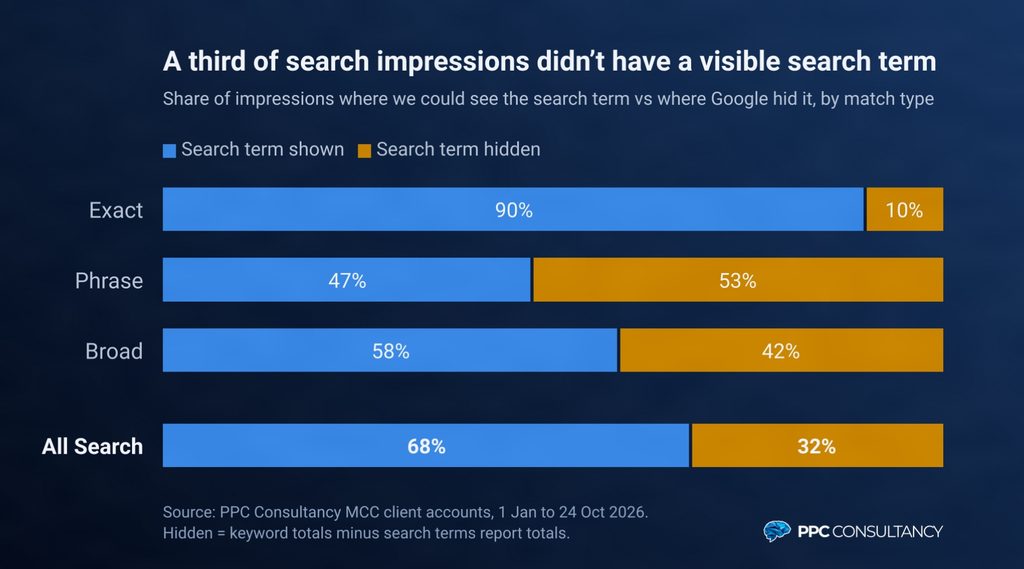
| Match type | Hidden impressions | Hidden clicks | Hidden spend |
| Exact | 10.0% | 8.0% | 14.4% |
| Phrase | 52.7% | 59.5% | 60.5% |
| Broad | 41.6% | 53.6% | 50.0% |
| All Search | 32.4% | 26.7% | 33.8% |
The vast majority of Exact match impressions and clicks have a search query against them. By design, Exact match can predominantly target high-volume, short-string queries. Phrase match is the least transparent match type you can buy in Google Ads: 60% of Phrase spend had no query, which is worse than the 50% Meyerson measured two years ago. For every £1 we spent on Phrase, 60p was a blind buy. Interestingly, Broad split down the middle at 42% hidden searches. Basically, the loosest match type showed us more search queries than Phrase.
Hidden traffic performs about the same, except on Exact match
By clicks, the hidden share falls to 27%.
Next, we looked at the actual value of visible traffic vs hidden traffic. Hidden clicks cost 40% more, had a 24% lower CTR, and a 50% higher CPA. If we’d stopped there, this piece would read as confirmation that hidden traffic embodies a critical amount of junk.
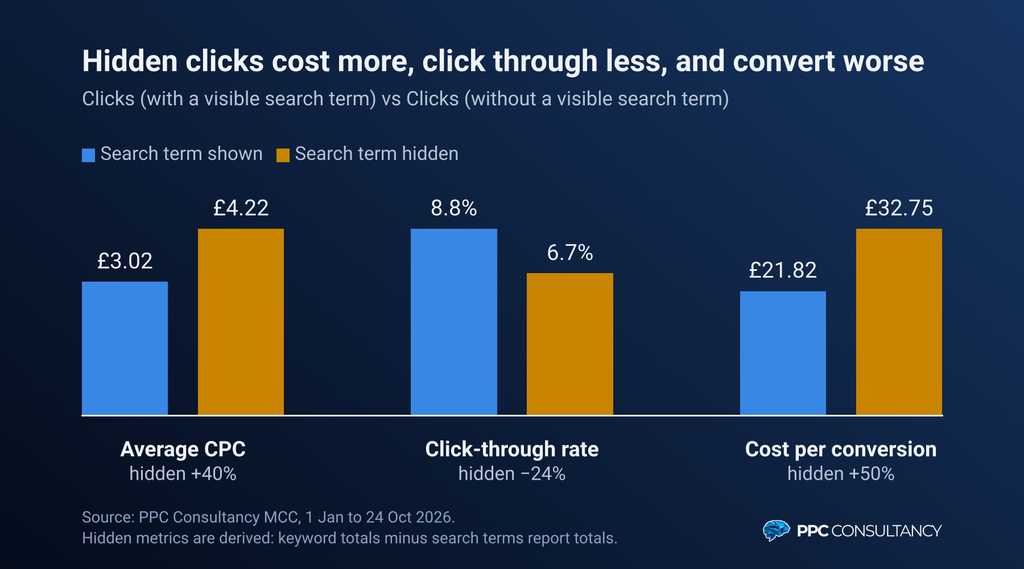
However, when split by account and match type, we see a different picture. Hidden traffic performed about the same as visible traffic in nearly every combination. Conversion rates landed within a couple of points either way, and CPA within 9%. The exception to this was Exact match, which explains the underperformance of hidden terms in the aggregate. In the worst-case scenario, Exact match clicks with hidden search terms cost 55% more than clicks with visible ones. The same pattern showed up in other accounts, with hidden Exact clicks costing us over 20% more.
Looking at the fine detail, it turns out this is a mix problem. 75% of visible Exact clicks were Brand searches, people already looking for the client. Google hid 28% of search terms coming from Brand clicks. Naturally, Brand clicks cost about a third of Non-Brand clicks. Therefore, the visible pile was full of cheap Brand clicks, and the hidden pile wasn’t. This is why the hidden pile looks expensive and performs poorly when you compare the two. On a like-for-like basis, hidden Non-Brand Exact clicks were 17% cheaper than visible ones, at about the same cost per conversion.
| Match type | CPC gap | CVR gap | CPA gap |
| Exact | −6% to +55% | −21% to +17% | +1% to +95% |
| Phrase | −6% to +8% | 0% to +10% | −8% to +4% |
| Broad | −6% to −4% | −9% to +6% | −9% to +3% |
Each range runs across the accounts in the study. A positive number means the hidden side was higher than the visible side. As everywhere in this report, hidden figures are the keyword totals minus the search terms report totals.
Hopefully, you found this useful. We plan is to update this report annually and keep track of how this form of Google tax changes over time. Our hope is that Google eventually revisits this policy and restores full search term visibility for all advertisers.
Are you spending more than £10,000 a month on Google Ads and looking to improve your performance?
Most accounts we audit are leaving at least 25% of upside on the table due to structural and tactical inefficiencies. Request a free Google Ads audit, we’ll audit your account and tell you what we’d fix first, no strings attached.